

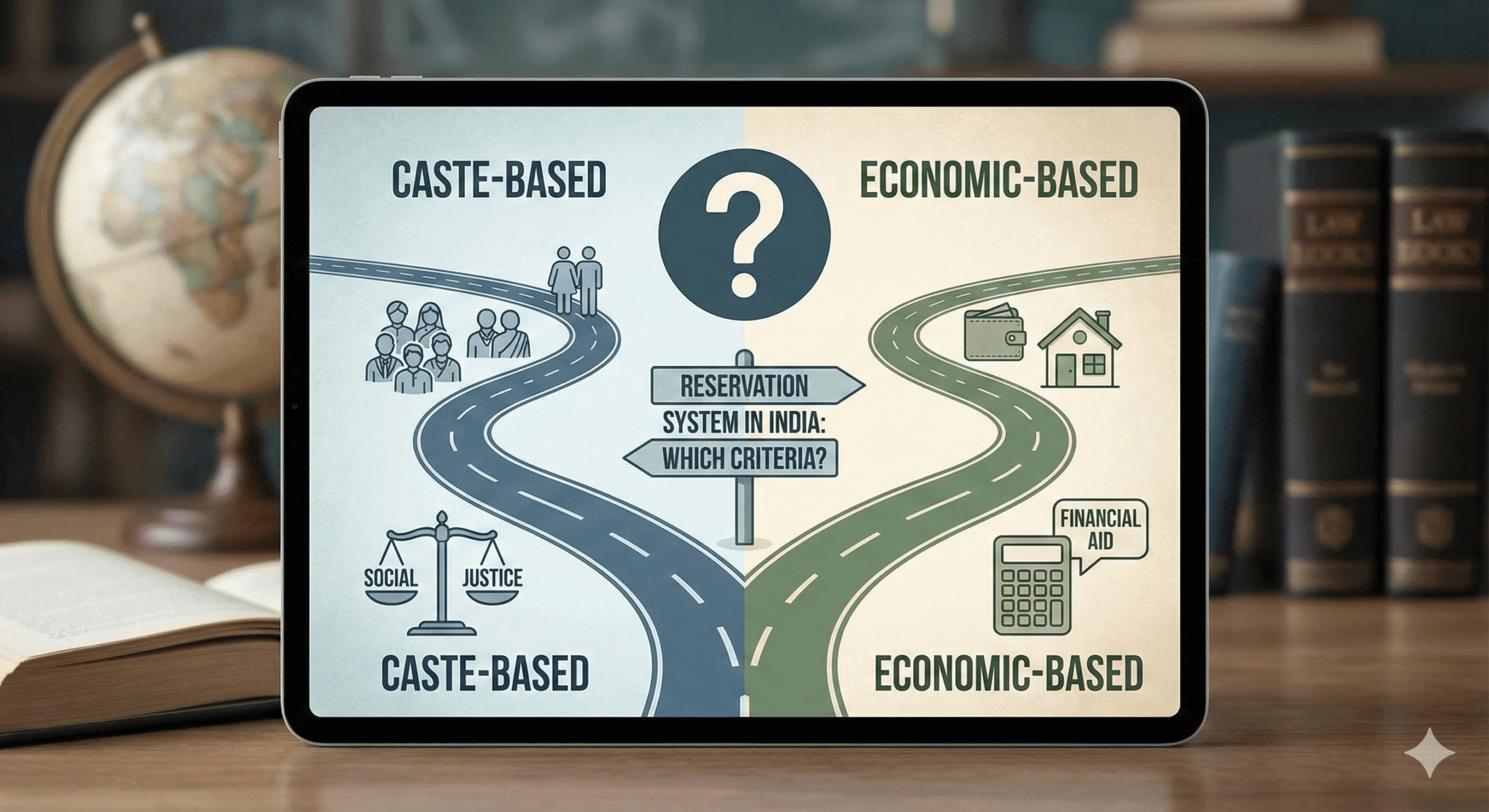
Reservation system is one of India’s most emotionally charged and politically sensitive issues.
It aims to correct historical injustices — but the debate has now shifted to a major question:
👉 Should reservation continue to be caste-based, or should it shift to economic-based reservation?
Let’s break the debate clearly, fairly, and in simple language.
🏛️ Why Does Reservation Exist in India?
The Indian reservation system was originally designed to:
- Address historical discrimination against SC/ST/OBC communities
- Give access to education, employment & political participation
- Correct deep-rooted social and structural inequality
- Uplift communities denied dignity and opportunity for centuries
The Constitution makers saw reservation as a temporary corrective tool — not merely a poverty-alleviation program.
🔥 The New Debate: Caste-Based vs Economic-Based Reservation
With rising literacy, urbanization, and economic changes, many argue that caste-based reservation system isn’t enough.
Economic inequality is now a major barrier too.
This tension has led to a strong public debate across India.
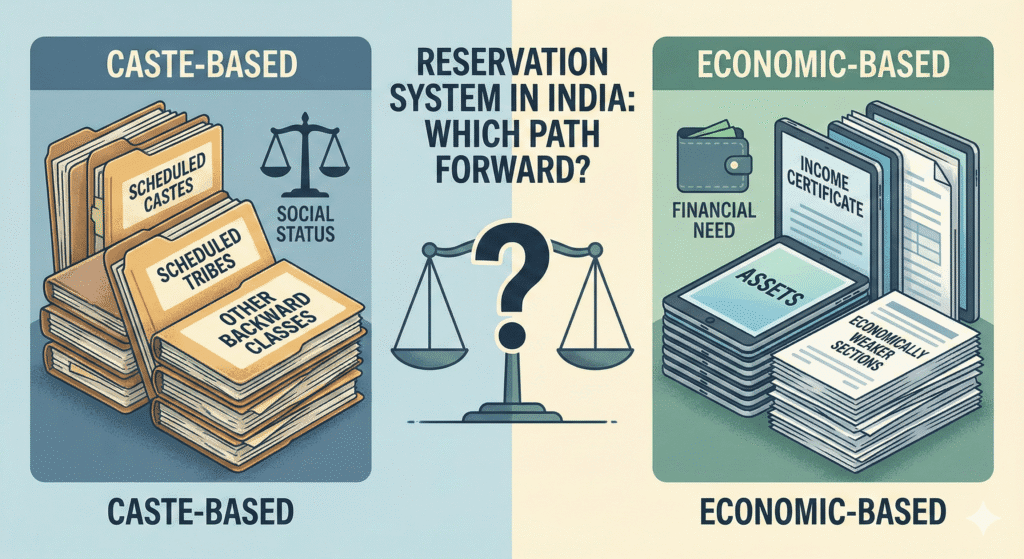
✔️ Arguments FOR Economic-Based Reservation
1. Poverty Exists Across All Castes
Many families from forward castes face:
- Poverty
- Unemployment
- No access to coaching
- Zero social capital
Economic reservation helps them.
2. Caste Alone Doesn’t Define Disadvantage
Some people from reserved categories today are:
- Educated
- Urban
- Economically stable
Yet they still receive reservation, leading to debates about fairness.
3. Meritocracy Concerns
Economic-based reservation is seen as more:
- Fair
- Modern
- Merit-friendly
It ensures benefits go to the poor, not just based on birth.
4. Reduces Social Tensions
Some believe economic criteria might:
- Reduce caste conflicts
- Decrease resentment
- Bring equality in perception
5. Already Introduced via EWS Quota
Government introduced EWS (Economically Weaker Section) quota in 2019 for poor upper-caste citizens.
This strengthens the argument for economic criteria.
❌ Arguments AGAINST Economic-Based Reservation
1. Reservation is for Social Backwardness, Not Just Poverty
Caste-based discrimination:
- Reduces opportunities
- Affects social status
- Causes bias in hiring
- Limits networks
Money alone cannot erase social stigma.
2. Poverty is Temporary — Caste is Permanent
Economic condition changes with time.
Caste-based exclusion continues across generations.
3. Social Inequality Still Exists
Even today:
- SC/ST students face discrimination
- Many rural areas still restrict access
- Network barriers limit opportunities
Economic reservation doesn’t address systemic caste bias.
4. EWS Already Covers the Poor
Economic reservation already exists.
Replacing caste reservation entirely may:
- Hurt historically oppressed groups
- Reverse decades of progress
5. Practical Implementation Issues
Who decides “poor”?
How to verify income?
What about hidden wealth?
Economic criteria can be easily manipulated.
⚖️ Balanced Middle Ground (Experts Suggest):
A mixed model is gaining support:
✔️ Keep caste-based reservation, but refine it
- Exclude the creamy layer in OBC
- Consider similar filters for SC/ST (controversial but discussed)
✔️ Increase support based on economic criteria
- Scholarships
- Coaching
- Hostels
- Fee waivers
✔️ Combine both models in a rational formula
Many countries use multi-dimensional indicators instead of just one.
📢 Public Sentiment (Based on Trends & Surveys)
Urban Youth:
- Favor economic-based or mixed reservation
- Cite fairness & merit concerns
- Strong support for EWS quota
Marginalized Communities:
- Strongly support caste-based reservation
- View it as essential protection
- Fear rollback of hard-won rights
Academics & Legal Experts:
- Support reform, not removal
- Believe caste is still a strong factor
- Suggest transparency + periodic revision
Political Class:
- Divided
- Often influenced by vote-bank dynamics
- No political party wants to fully end caste-based reservation
📝
The reservation debate in India isn’t about “merit vs caste” — it is about what kind of inequality India wants to solve.
- Caste-based reservation corrects historical injustice and ensures representation.
- Economic reservation addresses poverty and modern-day financial inequality.
India’s best path forward may be a balanced, mixed model that considers both social and economic backwardness — without ignoring the realities of caste discrimination that still exist.
The debate will continue, but it must be handled with fairness, empathy, and a deep understanding of India’s complex social structure.
Other related posts:
SC upholds 10 per cent quota for EWS

